Project update
What full daytime cover actually looks like at a food processor
May 2026 · Equator Solar engineering team · 3 min read
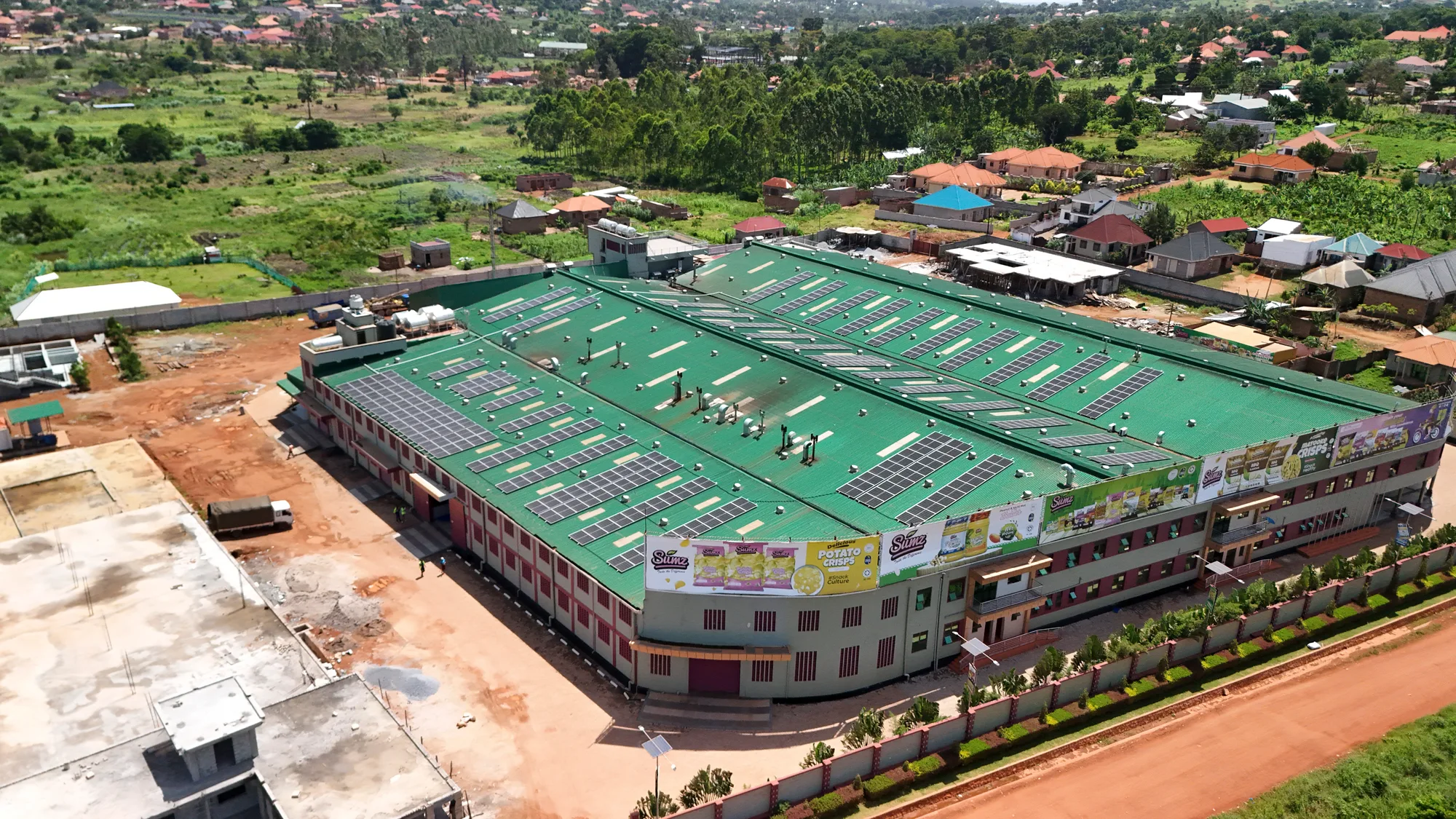
Sumz Food Industries in Nkoowe was scaling up for local and regional markets when we started work. That matters, because a growing processor has a load profile that is about to change, and a system sized against last year alone would have been wrong within a year.
Sized against the process load
The system is a 250 kWp grid-tied installation sized to cover the full daytime process load. Food processing suits that approach because the heavy loads run in daylight, exactly when a solar system is producing. There is no need to move energy from day to night, so there is no need to buy storage.
Where a client asks us to add batteries to a profile like this, we usually ask what problem the battery is solving first. On this site the honest answer was none, and leaving storage out kept the money in generation.
Zero feed-in, by necessity
The system is set to zero export, because Uganda does not offer net metering (where the utility credits you for surplus power) to commercial and industrial users, so any surplus the panels produce has nowhere to go. That constraint drives the sizing directly. If the array is oversized against the daytime load, the extra capacity is simply curtailed, meaning it is held back unused, and the money spent on it buys nothing.
Delivered under a PPA
The system was financed by a finance partner under a power purchase agreement (PPA), so Sumz pays for the energy it uses rather than for the hardware. We do not provide the funding ourselves. Our part is to design and build to a standard that a financier is prepared to back for the length of the contract, which is a useful discipline in itself.
The project
Sumz Food Industries
250 kWp grid-tied PV · Nkoowe, Uganda · 2025
All project references →Solar for Industry and Agro-Processing →More from the Knowledge Hub
Project update
Seven years, three systems, and a CT scanner at Naggalama
A hospital relationship that started with 12 kWp in 2019 now carries a CT scanner through grid interruptions. Here is what changed at each step, and why.
Technology brief
Why we specify LFP over NMC on weak grids
A battery on a weak Ugandan grid works harder than the same battery in a stable market. Chemistry choice follows from that, and so does service life.
Project update
Solar on a site that never switches off
Next Media Park in Kampala has 86 kWp of PV and 96 kWh of storage. Broadcast runs 24 hours a day, which changes what a solar system has to be.
Technology brief
Zero feed-in: what it means when the grid will not take your surplus
Uganda has no net metering for commercial and industrial users. That single fact shapes how every grid-tied system on this site gets sized.